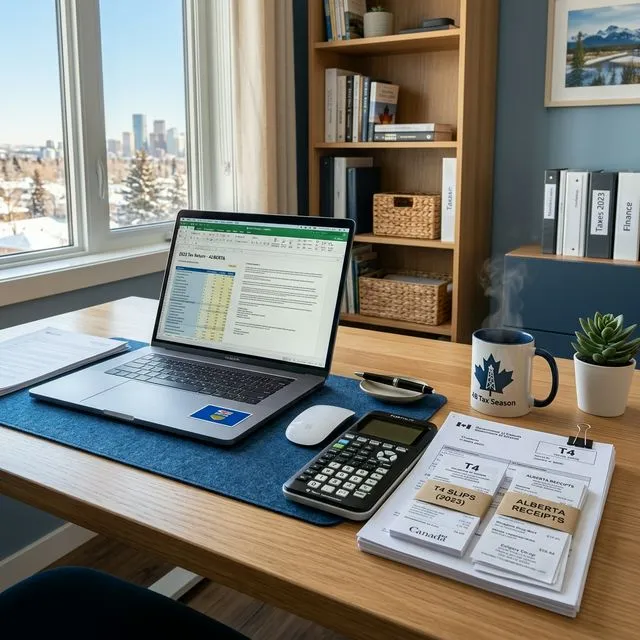
Tax season runs from late February to April 30 in Canada. For most Alberta residents, the deadline to file your personal tax return (T1) is April 30. If you or your spouse are self-employed, you get until June 15 to file — but any balance owing is still due April 30.
Step 1: Gather Your Documents
Collect all income and deduction slips before you file. Common documents include:
- T4 slips: From your employer
- T5 slips: Investment income
- RRSP receipts: Your contributions
- T2202: Tuition amounts
- Misc Receipts: Medical, Charitable, Daycare
The Walkthrough: Steps 2-5
-
Choose Your Filing Method
File online using software like TurboTax or Wealthsimple Tax (NETFILE), or use a CPA or professional preparer for more complex returns.
-
Enter Your Income
Report all income sources: employment (T4), investments (T5/T3), rental income, government benefits, and pension payments.
-
Claim Deductions
Deductions like RRSP contributions, childcare, moving expenses, and union dues directly reduce your taxable income.
-
Apply Tax Credits
Tax credits (like medical expenses or charitable donations) reduce the actual tax you owe, dollar-for-dollar.
Alberta-Specific: The AB428 Form
Alberta's provincial income tax (AB428) is calculated separately. The Alberta basic personal amount for 2025 is $22,323 — meaning you pay no provincial tax on those first dollars.
When to Hire a CPA vs. DIY
Doing your own return makes sense for simple returns with one T4. However, you should consider professional help if:
- You have self-employment or freelance income
- You sold a property (even your principal residence)
- You have rental income or complex investments
- You moved to or from Canada during the year
- You received a CRA letter or audit notice
The Value Beyond the Form
A CPA isn't just about filing accurately — it's about finding every deduction and credit you didn't know you were entitled to. Often, the tax savings outweigh the fee entirely.