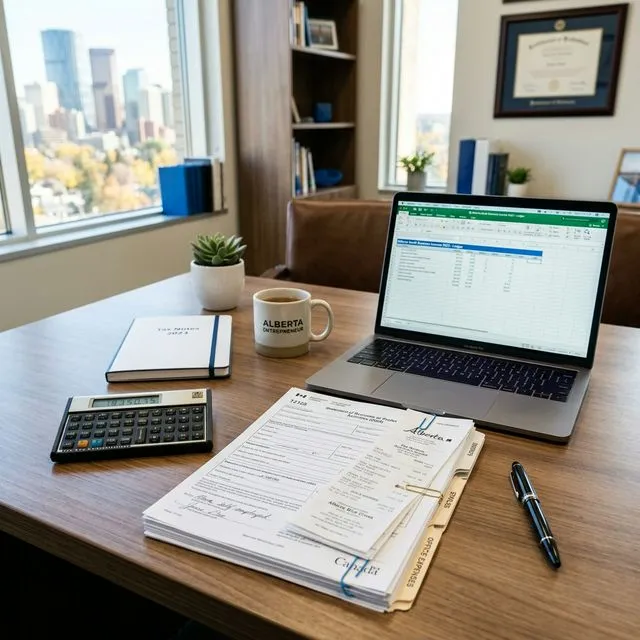
Freelancer, contractor, consultant — whatever you call yourself, you're leaving money on the table if you don't know what you can claim. One of the best things about being self-employed in Canada is the ability to deduct your business expenses from your income.
This directly lowers how much tax you pay. The bad news? A lot of self-employed Albertans miss deductions they're fully entitled to — either because they didn't know, or they didn't keep the receipts.
Quick Filing Note
You'll report your income and expenses on Form T2125 (Statement of Business or Professional Activities), which attaches to your personal T1 tax return. Use this checklist to ensure that form is as accurate (and profitable) as possible.
1. Home Office Expenses
If you use part of your home exclusively and regularly for work, you can deduct a portion of your home costs. This formula is simple: divide your office's square footage by your home's total square footage. That percentage applies to:
- Rent (if you rent your place)
- Mortgage interest (not the principal)
- Utilities: Electricity, heat, internet
- Cleaning supplies used in the office area
The Golden Rule of Losses
You cannot use home office expenses to create or increase a business loss. You must carry unused amounts forward to future years.
2. Vehicle Expenses
If you drive for work — not just to commute, but for client visits, pickups, or travelling between sites — you can claim a portion of your vehicle costs. You MUST keep a mileage logbook.
Deductible Vehicle Costs:
- Gas and oil
- Insurance & Registration
- Repairs and maintenance
- Lease payments or Capital Cost Allowance (CCA)
3. Professional Development
Courses, books, subscriptions, and workshops that help you run your business better or grow your skills are deductible. If it helps you earn income, it's likely fair game.
4. Office Supplies & Software
Beyond pens and paper, this includes your "digital office":
- QuickBooks or accounting tools
- Zoom or productivity subscriptions
- Adobe Creative Cloud or industry software
- Website hosting & domain fees
The 50% Rule (Meals & Entertainment)
Taking a client to lunch? You can only deduct 50% of the cost. Keep the receipt and write the name of the meeting on the back.
5. Professional Fees & Insurance
Your accounting fees and legal fees are fully deductible business expenses. Yes — paying a CPA to do your taxes is itself a tax deduction. You can also claim insurance for Errors & Omissions (E&O), liability, and business property.
6. CPP: The Self-Employed Reality
As a self-employed person, you pay both the employer and employee portions of CPP (approx. 11.9%). While this can be costly, half of what you contribute (the "employer" portion) is a direct deduction from your income.
Pro-Tip: Keep Every Receipt
Digital scans are perfectly acceptable. Organize them as you go so you aren't scrambling in April. If you're ever audited, your receipts are your only shield.
What You Can't Claim
- Personal expenses (groceries, home life)
- Fines and penalties (like speeding tickets)
- Club or gym memberships
- The personal portion of any mixed-use expense